From Sewage to Surveillance: ADB Highlights Wastewater Surveillance Work Led by Emory University in Nepal and the Philippines
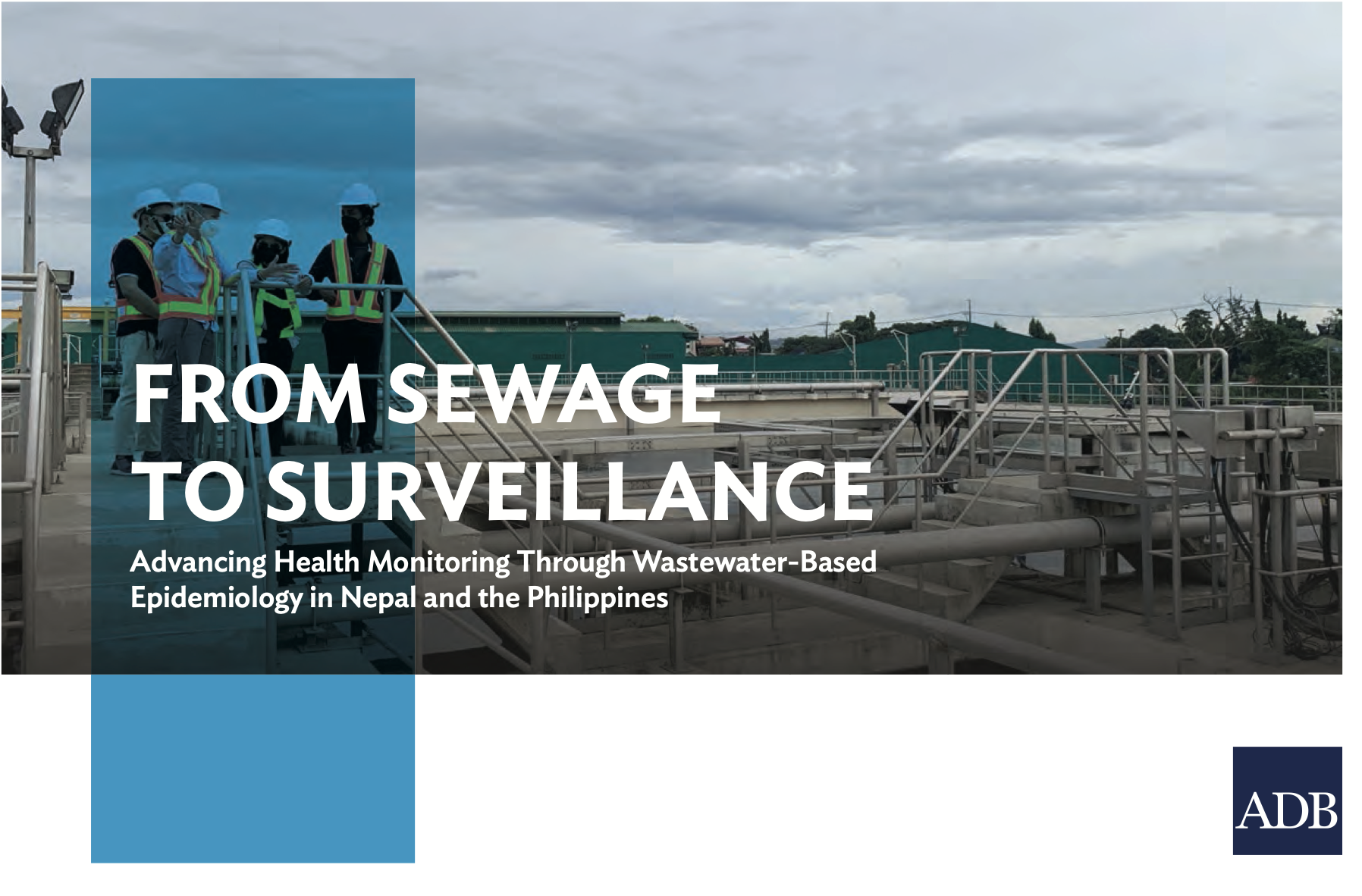
The Asian Development Bank (ADB) has published a new flagship brief, From Sewage to Surveillance: Advancing Health Monitoring Through Wastewater-Based Epidemiology in Nepal and the Philippines, documenting wastewater-based epidemiology (WBE) pilot programs implemented in Nepal and the Philippines.
The work was led by Emory University’s Center for Global Safe Water, Sanitation, and Hygiene, which was engaged by ADB under its Accelerating Sanitation for All in Asia and the Pacific technical assistance. Several technical leads on the project also serve as founders and core team members of SaniPath International, bringing long-standing experience in sanitation-linked health risk analysis, surveillance design, and capacity building.
Transforming Sanitation Systems into Public Health Surveillance
The publication highlights how wastewater-based epidemiology can complement traditional disease surveillance by detecting pathogen signals at the population level — including among asymptomatic individuals and communities with limited access to healthcare.
Pilot activities in Kathmandu Valley, Nepal, and Metro Manila, Philippines focused on:
Establishing or strengthening molecular biology laboratory capacity
Designing context-specific wastewater and fecal sludge sampling strategies
Training utility, laboratory, and government partners in PCR testing, data management, and interpretation
Integrating wastewater surveillance data into broader public health decision-making frameworks
The pilots successfully detected SARS-CoV-2 in wastewater in both countries and demonstrated the feasibility of expanding surveillance to additional pathogens, including Vibrio cholerae, through multiplex testing approaches.
Technical Contributions from the SaniPath Team
Several members of the Emory-led technical team contributing to the pilots are also core members of SaniPath International, bringing experience from over a decade of applied research and implementation linking sanitation conditions, environmental contamination, and public health risk.
This work reflects a shared technical foundation between Emory and SaniPath International, grounded in:
Environmental and wastewater sampling strategy design
Pathogen detection and laboratory workflow optimization
Data integration, visualization, and interpretation for policy and operational use
Capacity building for local institutions and utilities
Why This Work Matters
As highlighted in the ADB publication, wastewater surveillance offers a powerful, cost-effective complement to clinical surveillance by providing:
Earlier detection of disease trends
Population-level coverage, including underserved communities
Multi-pathogen monitoring using existing sanitation infrastructure
Strong alignment with urban sanitation, climate resilience, and epidemic preparedness priorities
The Nepal and Philippines pilots demonstrate that WBE is no longer a proof of concept, but a practical tool ready for institutionalization within public health and sanitation systems.
Read the full ADB publication: From Sewage to Surveillance: Advancing Health Monitoring Through Wastewater-Based Epidemiology in Nepal and the PhilippinesLooking Ahead: SaniPath International’s Goals for 2026
Building on this work, SaniPath International’s priorities in 2026 focus on scaling and institutionalizing environmental surveillance as a core component of climate-resilient public health systems.
As climate change accelerates flooding, heat stress, and sanitation system failures—particularly in rapidly urbanizing settings—the need for integrated, environmental early-warning systems will only grow. These same systems are increasingly critical during climate-related disruptions, when traditional health data systems are slow, incomplete, or inaccessible. In 2026, SaniPath aims to:
Expand wastewater- and environment-based surveillance beyond emergency response, supporting routine, multi-pathogen monitoring embedded within sanitation and utility systems
Strengthen links between climate stressors and health risk, using environmental surveillance data to inform climate adaptation, urban resilience, and sanitation investment decisions
Support country-led surveillance systems, prioritizing capacity building, governance, and data use by local institutions rather than parallel pilot structures
Bridge research and decision-making, translating complex environmental data ino actionable insights for ministries of health, utilities, and development banks
This direction reflects SaniPath International’s broader mission: to ensure that sanitation systems are not only protective infrastructure, but also strategic public health assets—especially as climate change reshapes disease risk in cities across Asia and beyond.